Mamata, Karunanidhi effect: MEA sees red as states veto foreign policy
Kudankulam stalemate over, PM to discuss N-safety at Korea summit next week
India's poser to US: If you won't dump Pakistan, why should we jettison Iran?
18 March 2012
As India negotiates the diplomatic minefield that is West Asia, questions are being asked of the government as to whether and how it could engage differently with Iran, Israel and Saudi Arabia, without having to taking sides or pick and choose one over the other.
New Delhi would have you believe that the overlapping tensions in West Asia, manifested in the Israel-Iran stand-off over the latter's nuclear ambitions, the proxy war being played out in Syria between a Shiite Iran and the Sunni-bloc led by Saudi Arabia, or more generally the competition between Saudi Arabia and Iran for supremacy, constrict India's options.
In an example of some nimble Indian diplomacy, the government despatched external affairs minister SM Krishna to Israel and defence minister AK Antony to Saudi Arabia in order to offset any adverse fallout from Prime Minister Manmohan Singh's proposed visit to Iran later this year. However, the same government chose in its wisdom to support a UNSC resolution against Syria.
While there is merit in New Delhi's argument, an influential section of the Indian diplomatic community contends that the ongoing investigation into the attack on an Israeli envoy in New Delhi or the threat of US sanctions on Indian entities post-June 28 for not reducing oil imports from Iran should not deter the government from pursuing what it deems is in its enlightened national interest.
"The US not only does not choose between India and Pakistan but actually assists our adversary in many ways, so why should we forego our limited relationship with Iran for the sake of the US?" wondered Kanwal Sibal, a former foreign secretary.
"Do Iran and Saudi Arabia choose between us and Pakistan? If at all they have been historically closer to Pakistan than to us. If Iran's statements on Israel and the Holocaust are objectionable, the Wahabi ideology emanating from Saudi Arabia is objectionable too. We should safeguard our energy relationship with Iran as best as we can despite US and EU sanctions and the Arab position," Mr Sibal told this newspaper.
Increasingly, diplomats who have observed or served in the region insist that India's relationship with Iran should stand on its own feet and not linked to its relations with Saudi Arabia. They maintain that whatever the differences between Iran and Saudi Arabia, and the Shia-Sunni conflict that is building up, India does not need to take sides or feel compelled to choose.
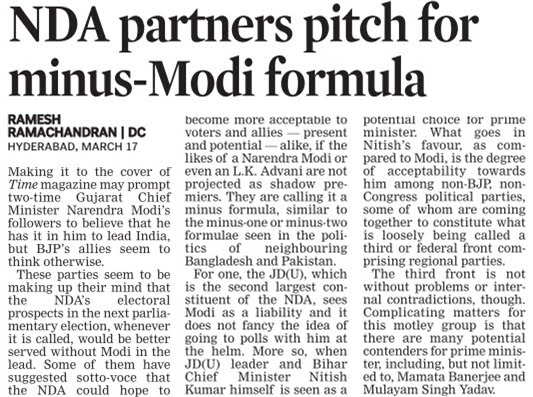
BJP's NDA partners pitch for minus-Modi formula for next parliamentary election in order to bait new allies
Gujarat Chief Minister Narendra Modi on the cover of the
26 March 2012 issue of the Time magazine of the U.S.
Indian minister calls for beefing up infrastructure at China border, moots a national rail policy

In the same breath, he pitched for evolving a national policy for Railways, so that there is continuity of policy across successive governments and policies can be executed without them falling a victim to partisan politics.
"... the time has come to think of a national policy for Railways, just as we have one for defence and for external affairs," Mr Trivedi said Wednesday in his budget speech in the Lok Sabha.
Uncharacteristically for a railway minister, Mr Trivedi spoke about how the geopolitical situation on borders arising out of building of state-of-art road and rail network by neighbouring countries "requires a matching response."
The Railways, he continued, must remain in a state of preparedness to move men and machines to border areas.
Mr Trivedi sought to impress upon the relevant ministries of the government, not least of all the ministry of finance, that it was therefore necessary to undertake projects of national importance on priority and to ensure adequate funding.
Similarly, he argued for liberal funds for connecting the remote and backward areas in Jammu and Kashmir and the north-eastern states, without worrying about the return on investment or such other factors.
He warned that the projects in J&K and in the north-east, which required more than Rs 4,000 crore for the current year, may get delayed for want of adequate funding.
"The budgetary support to Indian Railways has been pegged at a modest level of Rs 24,000 crore as against a projected requirement of Rs 45,000 crore. The national projects in Kashmir and northeast region have also to be funded out of this," he said.
In his speech, Mr Trivedi also dwelled on how the Indian Railways was contributing its bit for improving India's relations with her neighbours. He cited the proposed Tripura-Bangladesh railway link, and the new Jogbani-Biratnagar line and Jaynagar-Bijalpura-Bardibas to provide connectivity to Nepal as a case in point.
Indian prime minister Manmohan Singh to visit Iran despite regional tensions
Prime Minister Manmohan Singh's much-anticipated visit to Iran this year can be expected to serve the dual purpose of maintaining India's ties with Iran on an even keel and kickstarting peace talks with Pakistan.
Tehran will host the 16th Non-Aligned Movement (NAM) summit in September.
His visit to the Iranian capital will, literally, be couched in nonalignment, coming as it will in the midst of a brewing crisis in West Asia, between Iran and Israel, and between the Shiite and Sunni blocs represented by Iran and Saudi Arabia, respectively.
It will follow the visits by external affairs minister SM Krishna to Israel, and defence minister AK Antony to Saudi Arabia. Also, it will be the first visit by an Indian premier to Iran in over a decade, after Atal Bihari Vajpayee's in 2001.
Prime Minister Singh's proposed visit to Tehran is being described as a manifestation of India's balanced and equitable relationships with various protagonists in the region. A broad-based relationship with the region is a welcome shift in policy, particularly after the narrow-minded pursuit of interests in the run-up to the signing of the India-US nuclear deal.
India and Pakistan are among the 120 members of the NAM. Besides interacting with the host, President Mahmoud Ahmadinejad of Iran, Prime Minister Singh is likely to re-engage his Pakistan counterpart, Yousuf Raza Gilani, on the margins of the summit.
The prime ministers of India and Pakistan last met in November 2011 on the sidelines of the Saarc summit in the Maldives. Incidentally, it was on the margins of the last NAM summit, hosted by Egypt in the Red Sea resort of Sharm-el-Sheikh in 2009, that prime ministers Singh and Gilani agreed to insulate the peace talks from "action on terrorism".
Prime Minister Singh will be hoping that peace with Pakistan will be his legacy, as India heads for elections in 2014. The Singh-Gilani talks will be preceded by Mr Krishna's visit to Islamabad.
The Asian Age, New Delhi

India slow off the block or ..? China likely to bag Israeli rail project
Indians safe in Syria, no travel advisory for now
From Left, the clipping from The Asian Age; the International page of the Bengaluru edition of Deccan Chronicle; and the clipping of the article from the edition
New Delhi
4 August 2011
Some Indian nationals living in Syria have shifted from the city of Hama, which has witnessed protests, to Aleppo, the largest city after the capital Damascus.
Similarly, a few Indians living in the Syrian province of Deir ez-Zor have moved to safer areas in the same province following the recent unrest.
There are about 1,000 Indian nationals in Syria and all of them were reported to be safe. There were no reports of casualties or injuries to Indian nationals.
A majority of the Indian nationals, about 600 of them, including their families, are located at the Shia shrine of Sayidda Zeinab, on the outskirts of Damascus, where they learn the religious scriptures.
Some 300-odd Indians live in Damascus, and another 35, mostly oil workers, in the province of Deir ez-Zor. The remaining Indian nationals are scattered across Syria.
Unlike some countries, India does not intend to issue a travel advisory warning its nationals to leave Syria or to not to travel to Syria. Their evacuation is ruled out for now.
New Delhi has sought to justify its stand by saying that its assessment is different from that of some other countries whose decisions are clouded by political factors. It has determined, using its mission in Damascus and other means, that the situation inside Syria is not as bad as it is made out to be by a section of media, mostly based in the US and Europe. Also, the casualty figures are exaggerated by the particular section of media.
There were only pockets of protests, and the capital Damascus and Aleppo, two of Syria's largest cities, have remained quiet. Moreover, the families of diplomats of some countries, who had been asked to leave Syria following the outbreak of violence, were reported to be returning to Damascus. At the same time, India does not anticipate a problem in relocating its nationals from Syria if the situation worsens because their population is small, unlike Egypt, Libya or Yemen.
The sentiments of India, which is the president of the United Nations security council (UNSC) for the month of August, are shared by some other non-permanent UNSC members who have since issued a presidential statement, as opposed to a resolution, voicing its concern over the developments in Syria.
Sanctions won't help, a combative Syrian vice foreign minister Faisal Mekdad warns US allies; Damascus banks on IBSA support in UNSC
The EU on Tuesday added Syrian defence minister Ali Habib Mahmud and four others to its sanctions blacklist.
In an exclusive interview to this newspaper in New Delhi, a combative Syrian vice foreign minister Faisal Mekdad accused the US, EU and Israel of "provoking" violence in his country and attempting to do a Libya in Syria.
He is reasonably sanguine that the IBSA (India, Brazil and South Africa), all three of whom currently are non-permanent UNSC members, along with Russia and China, would not encourage adoption of the resolution.
"What prevented the Security Council for the last three months from adopting a resolution is the understanding shown by the friends of Syria. I think this time their [the US and its European allies] attempts will fail again," he said.
The only time Mr Mekdad struck an apparently conciliatory note was when he said that Syria was "ready to cooperate with Europe" provided the terms of engagement were "on equal basis with mutual respect and understanding".
However, he was categorical that "if the objective of the US and its European allies was to help Israel preserve its hegemony and exercise its hegemony on the entire region then they are wrong."
"... what we are looking for is just and comprehensive peace where Israel withdraws from the occupied Arab territories from West Bank and Gaza, from the Syrian Golan and from southern Lebanon, and establishment of an independent Palestine state. This is the way we can establish [peace] but their support of Israel and their attempts to give Israel the peace and the land will lead nowhere."
Mr Mekdad noted that Syria was paying a price for being "the last post of resistance against European, American and Israeli pressures."
He added: "Any meeting between post-Hosni Mubarak Egypt and Syria is very dangerous for American and Israeli and Western interests in the region. That is why they have to destroy Syria before it establishes good, normal relations with new Egypt."
Mr Mekdad, who called on external affairs minister SM Krishna on Monday, said the "help and support received from India at international fora is very important."
India on Monday assumed the rotating presidency of the UNSC for the month of August.
Calling for "strategic" ties between India and West Asia generally and Syria in particular, Mr Mekdad said, "Syria and developing countries should now look to the east rather than to the west [and we] need to develop South-South cooperation."
India says CBMs will be a success only if Pakistan creates right atmosphere by taking prompt 26/11 action; Fai's arrest a "very important development"
New DelhiThe observation should be seen in the context of the forthcoming talks between external affairs minister SM Krishna and his Pakistan counterpart, Ms Hina Rabbani Khar, to be held in New Delhi on July 27.
India was expected to announce some CBMs, some unilateral, others bilateral on a reciprocal basis, after the Krishna-Khar meeting, the agenda of which would be firmed up on July 26 when foreign secretary Nirupama Rao meets with her counterpart, Salman Bashir.
The CBMs could extend to increases in the number of days for cross-LoC trade and duration of entry permits, improvement in the Srinagar - Muzaffarabad and Poonch - Rawalakot bus services, and facilities such as telephone fortraders. Islamabad was hesitant about introducing banking services for traders.
By October, Pakistan was likely to shift from a positive list of items that can be imported from India to a system of trade based on negative list of items. In other words, Pakistan would effectively be implementing Most Favoured Nation (MFN) status for India.
Some items on the agenda of the India - Pakistan Joint Commission, such as agriculture, education and telecommunications, could fall in the purview of future discussions.
The source maintained that no dramatic, big-bang announcements should be anticipated. Even if the bilateral relations were to improve incrementally, India would at least be satisfied at having pulled the dialogue out of life support, post-26/11, and draw confidence from the fact that the sequence of bilateral meetings was sustained despite the odds.
It was pointed out that India would be willing to talk on "all" issues, including, but not limited to, Jammu and Kashmir. However, the source noted, it takes two hands to clap, and Pakistan needs to take a call on that.
Meanwhile, New Delhi has described the arrest of Ghulam Nabi Fai as a "very significant development". Fai is accused of having links to a decades-long effort that allegedly funnelled millions of dollars from the Inter Services Intelligence (IS), Pakistan's external intelligence agency, to fan anti-India sentiments and push Pakistan's subversive agenda over the issue of Jammu and Kashmir.
New Delhi did not discount the possibility that Fai's arrest could have something to do with the recent tensions in the US - Pakistan relations, but from India's point of view the "die has been cast".
The source said it was a "good thing" that enlightenment has finally come to the US, and it will hopefully come to other countries such as Britain and Belgium, too. Certain individuals and groups are known to be carrying out anti-India activities from London and Brussels.
Fai's arrest also validates India's position that the separatists' agenda in Jammu and Kashmir receives most of its sustenance from Pakistan. In the same breath, the source said that Pakistan's foreign minister should seek to impress upon the separatists she would be meeting in New Delhi to speak the language of peace and reconciliation.
Stapled visas by China upsets India, again
India has expressed disappointment over the issue of stapled visas by China to five sportspersons from Arunachal Pradesh in spite of a recent understanding reached between their officials.
"We are still searching for a de-stapler. We are obviously not amused" by the fact that they continue to issue stapled visas for our nationals, a government source said.
Recently, the Chinese embassy in New Delhi issued stapled visas to five karate players from Arunachal Pradesh, a step that ensured that they could not take part in an international championship in China as these documents were not valid for travel.
The action by China came close on the heels of the claims made by officials here that the issue has been resolved and was also reflected in the resumption of the Indo-China defence exchanges.
As Krishna leaves for Indonesia, Clinton asks India to counter China's aggression with assertiveness; Manmohan Singh to skip Commonwealth summit

External affairs minister SM Krishna will travel to Bali for the ninth India-Asean post-ministerial conference, the East Asia Summit (EAS) foreign ministers' consultations, and the Asean Regional Forum ministerial meeting on Friday and Saturday.
The situation in east Asia was discussed in the India-US strategic dialogue in New Delhi on Tuesday. The issue figured in US secretary of state Hillary Clinton's speech in Chennai on Wednesday, in which she urged India to be assertive in Asia.
"India's leadership has the potential to positively shape the future of the Asia-Pacific [and] we encourage you not just to look east, but continue to engage and act east as well," Ms Clinton said.
"The US has always been a Pacific power because of our very great blessing of geography, and India, straddling the waters from the Indian to Pacific Oceans, is with us a steward of these waterways".
She reminded New Delhi that with increased power comes increased responsibility. "As India takes on a larger role throughout the Asia-Pacific, it is also taking on new responsibilities including the duty to speak out against violations of universal human rights" in Burma, she said.
Ms Clinton and other foreign ministers, including Hina Rabbani Khar of Pakistan, would participate in the Bali meetings.
Ms Rabbani-Khar was scheduled to visit India next week for talks with Mr Krishna but they could exchange pleasantries on the margins of their meetings in Bali. However, the prime ministers of India and Pakistan would have to wait till the Saarc summit in Maldives in November for a possible meeting.
Indian and Pakistani leaders could have met in Perth, Australia, on the sidelines of the Commonwealth Heads of Government Meeting in October but Prime Minister Manmohan Singh has opted out of attending it. In his place, Vice President Hamid Ansari would be leading the Indian delegation.
Hillary Clinton - SM Krishna strategic dialogue long on intent, short on strategy; US makes it clear to India that it will not dump Pakistan
Ms Clinton's remarks during the course of her talks with external affairs minister SM Krishna on Tuesday, and a joint media event which followed it, were littered with qualifications: The US will support full civil nuclear cooperation with India but the bilateral pact has to be "enforceable and actionable in all regards"; the US stands by the clean Nuclear Suppliers Group (NSG) waiver to India but the Indian nuclear liability law needs to be aligned with global practices; and, the US government cannot tolerate safe havens for terrorists anywhere but "we do see Pakistan as a key ally" in the war on terror and "we want a long-term relationship with" it.
There was no express commitment from Ms Clinton to either sell or to allow the sale of enrichment and reprocessing technologies to India following the NSG decision to bar their sale to non-NPT signatories such as India. There was no mention of it in the joint statement either. All she would venture to say in response to a question posed to her at the media interaction was that Washington supports the September 2008 clean waiver for India and it will push for India's membership of multilateral export control regimes such as the NSG.
Instead, Ms Clinton hastened to remind India of its commitment to ensure a level playing field for US companies seeking to enter the Indian nuclear energy sector. She voiced Washington's desire to see the Indian nuclear liability law tweaked to protect American corporate interests.
"We would encourage engagement with the International Atomic Energy Agency to ensure that the liability regime that India adopts by law fully conforms with the international requirements under the convention[.] We are committed to [the nuclear pact.] But we do expect it to be enforceable and actionable in all regards," Ms Clinton noted.
She also reminded New Delhi to ratify the Convention on Supplementary Compensation by the end of 2011. The treaty will allow foreign companies supplying nuclear material and technology to India to tap into a global corpus of funds in order to pay damages in the event of a nuclear accident.Amplifying Ms Clinton's remarks, the joint statement said that the participation of US nuclear energy firms in India should be on the basis of "mutually acceptable technical and commercial terms and conditions that enable a viable tariff regime for electricity generated."
Dwelling on regional issues, Ms Clinton said that Pakistan has "a special obligation to [cooperate] transparently, fully and urgently" in the interest of justice for the victims of the 26/11 terrorist attacks in Mumbai. She iterated that the US will continue to urge Pakistan to bring the 26/11 terrorists to justice but she qualified it by saying that "there is a limit to what both the United States and India can do".
Ms Clinton said that sale of defence technologies will help the Indian and American militaries to work together on maritime security, combating piracy, and providing relief to the victims of natural disasters. She also pushed for market access, reduction of trade barriers, and US investments in India, indicating that Washington viewed its ties with India in transactional, not strategic, terms.
For India's part, Mr Krishna sought to impress upon the American delegation that it was necessary for the US to factor in Afghanistan's ground realities and work closely with President Hamid Karzai's government so that conditions could be created where terrorists did not make any more advances in Afghanistan.
Mr Krishna said that India and the US had agreed to resume negotiations on a bilateral investment treaty. He urged the US to consider a "totalisation agreement" with India for the purpose of avoiding double taxation of income with respect to social security taxes. The agreement is essential for determining whether an Indian national is subject to the US social security or medicare tax or Indian social security taxes.
A bilateral aviation safety agreement and a memorandum of understanding on cyber security were the two tangible outcomes of the India-US dialogue.
Ms Clinton called on Prime Minister Manmohan Singh and met with UPA chairperson Sonia Gandhi, leader of opposition in the Lok Sabha Sushma Swaraj, and national security adviser Shivshankar Menon, among others.
Japan may suspend N-talks with India, puts Manmohan Singh's ambitious nuclear programme in jeopardy
programme risks being grounded even before it could take off with Japan
signalling its intention to suspend negotiations with India, and other
countries, for sale of nuclear-power equipment and technology.
Prime Minister Naoto Kan of Japan has indicated his personal preference
for phasing out nuclear power in his country. It could not have come at
a worse time for Prime Minister Singh, whose government is reeling
under the effects of a recent Nuclear Suppliers Group (NSG) decision to
restrict the sale of enrichment and reprocessing (ENR) technologies.
His government is also battling pressure from American government and
companies alike, to cushion the impact of Indias civil nuclear
liability law on the suppliers. That and the growing climate of
disenchantment with nuclear energy following the Fukushima disaster in
Japan could potentially unravel Prime Minister Singhs nuclear gambit
for which he has had to invest significant political capital in his
first term in office.
power technology and equipment. Compounding the problem for India is
that a delay in wrapping up the India-Japan bilateral nuclear pact will
pose a handicap for companies, both Japanese and foreign. Two major US
firms, General Electric and Westinghouse, are either partly or wholly
owned by Japanese companies. Even the French state-owned nuclear power
group Areva has a tie-up with Mitsubishi of Japan.
concluded negotiations for a reprocessing pact with the US which will
allow setting up of at least two dedicated facilities for reprocessing
US-origin spent nuclear fuel under IAEA safeguards. India and Japan
power. Both have adopted a closed fuel cycle, which entails management
of toxic waste by reprocessing the spent nuclear fuel. Also, they have
opted for a comprehensive fuel cycle, from mining to reprocessing. The
Rokkasho plant has built-in IAEA monitoring equipment and other
advanced design features and India can do with Japan's experience for
designing a state of the art, modern reprocessing facility here.
India and Japan have held three rounds of negotiations so far. Both
sides exchanged views on various aspects related to nuclear energy as
recently as April this year, during foreign secretary Nirupama Raos
talks in Tokyo. Both sides will continue to discuss the way forward
for cooperation in this sphere, a statement issued towards the end of
Mumbai terrorist attacks: Suspects not known, but Delhi is certain peace talks with Pakistan will continue
On the morning after the terror strike, he deployed two of his senior Cabinet colleagues, P Chidambaram and SM Krishna, to reassure an international audience, worried about the consequences of a downturn in India-Pakistan bilateral ties in the wake of another terrorist attack in Mumbai after 26/11, that he will stay the course on Pakistan.
Mr Krishna said that the blasts will have no impact on the talks with his Pakistan counterpart this month. Mr Chidambaram, in turn, said in Mumbai that while all hostile groups are suspects, he would not want to point a finger at any particular group just yet.
Their statements would have calmed fears somewhat, given the sentiment in a section of the international community that peace between Pakistan and India was a global imperative.
The degree of anxiety generated by the attacks could be gauged from a flurry of condolences from world leaders such as Asif Ali Zardari and Yousaf Raza Gilani of Pakistan, Barack Obama and Hillary Clinton of the US, Dmitry Medvedev of Russia, Nicolas Sarkozy of France, Stephen Harper of Canada, William Hague ofBritain, Julia Gillard and Kevin Rudd of Australia, the foreign ministries of Israel and Japan, and organisations such as the United Nations and the European Union.
However, domestic opinion was divided, with some Indians wondering whether relations with Pakistan had matured to the extent that one could begin to think in terms of moving away from presumption of guilt of elements hostile to the peace process. Also, some attempts to blame the Indian Mujahideen for the attacks were seen as a ruse to insulate New Delhi from criticism of its Pakistan policy.
At the same time, the government sought to defend itself by maintaining that there was nothing to be gained from fingerpointing, and, that its stand was in keeping with the spirit of Thimphu and Sharm-el-Sheikh.

At Sharm-el-Sheikh in July 2009, Singh and Gilani had agreed that action on terrorism should not be linked to the dialogue and the two should not be bracketed.
Further, it was pointed out that foreign secretary Nirupama Rao had recently said in aninterview to an Indian television channel that Pakistan's attitude towards tackling terrorism had "altered", and that its talk of tackling non-state elements was a "concrete development."

New Delhi's assertion, that talks with Pakistan will continue, could not have come a moment too soon for Mani Shankar Aiyar of the Congress party. Aiyar, a former diplomat and a former Union minister, may still not find a place in Prime Minister Singh's council of ministers but he has never tired of endorsing Mr Singh's hopes of ensuring that the peace talks with Pakistan become "uninterrupted and uninterruptible."